
Why Ball Charging Systems Block — And How to Fix Them Permanently
In most cases, these blockages are not caused by poor operation or lack of maintenance alone. They are the result of fundamental geometric and flow design issues, often introduced unintentionally through site modifications over time.
This article explains why ball charging systems block, the most common design mistakes that cause recurring failures, and how a structured engineering approach can restore reliable automated operation. A real‑world gold mine case study is included to illustrate the principles in practice.
Who This Article Is For
This article is intended for:
- Plant and maintenance managers responsible for mill availability
- Metallurgical and processing engineers
- Reliability and automation engineers
- Operations teams dealing with recurring ball charging interruptions
Common Causes of Ball Charging System Blockages
Ball charging blockages are rarely random. They typically originate from a combination of geometry, wear, and control philosophy.
Common contributors include:
- Chute widths that fall between whole numbers of ball diameters
- Site‑installed platework or liners that create unintended choke points
- Worn bunkers or hoppers with irregular internal profiles
- Removal or bypassing of monitoring and interlocks
- Poor synchronisation between feeders, vibration units, and control logic
While vibration and operator intervention may temporarily clear blockages, these measures rarely address the underlying cause.
Why Chute Geometry Causes Steel Balls to Lock
Steel balls behave very differently from granular bulk solids.
A key failure mechanism is spherical interlocking, where balls wedge together and form a self‑supporting arch inside a chute. This typically occurs when chute widths are:
- Too wide for two balls to flow freely, but
- Too narrow for three balls to pass side‑by‑side
This “in‑between” geometry creates ideal conditions for static wedging that cannot be resolved by vibration alone.
This must be distinguished from kinetic locking, which occurs momentarily during movement and can usually be cleared through vibration or flow control. Persistent blockages are almost always geometric in nature.
Case Study: Restoring an Automated Ball Charging System at a Gold Mine
The Challenge
At a large gold mine in West Africa, a steel ball charging system had never operated reliably in automatic mode. Over time, site teams introduced multiple modifications in an attempt to keep production running, including:
- Additional platework inside chutes
- Removal of pulsating weirs
- Bypassing of load cells and monitoring systems
While well‑intentioned, these changes introduced new choke points and eliminated the system’s ability to detect and respond to blockages. Operators were forced to feed balls one bag at a time and manually clear lodged media.
Investigation and Findings
A structured on‑site investigation identified several compounding issues:
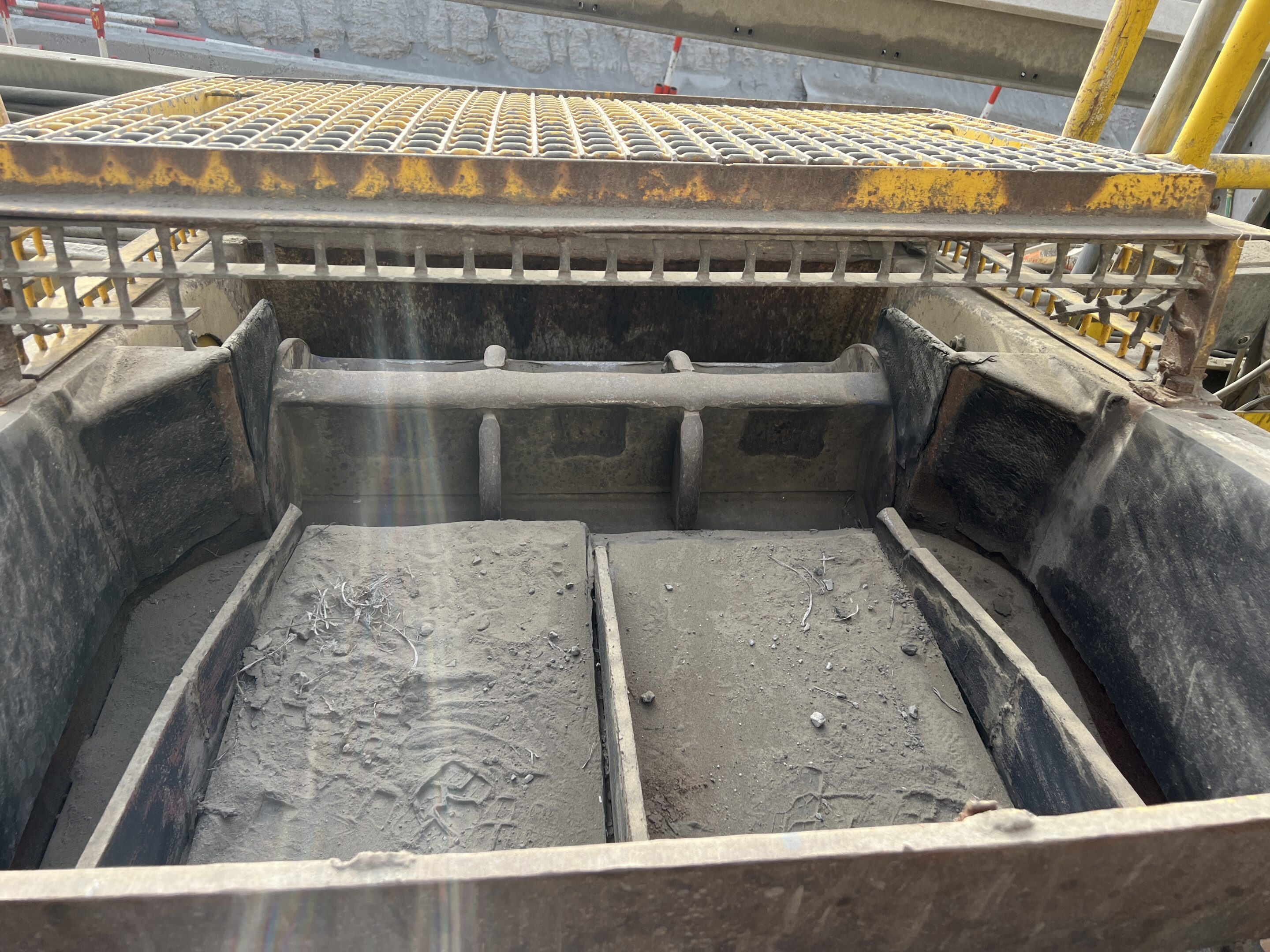
- Concrete bunker wear with uneven slopes, exposed reinforcement, and loose lining material restricting flow
- Secondary hopper deformation, contributing to inconsistent discharge
- Main chute narrowing, reduced from the original design width and split into narrow channels that promoted interlocking
- Modified rotary vane feeder, resulting in inconsistent ball discharge
- Removal of monitoring, leaving no feedback to detect flow interruptions
The investigation confirmed that the dominant failure mode was spherical interlocking driven by geometry, not operational error.
Testing and Validation
Controlled tests were conducted with site supervision:
- Removing internal plates significantly improved flow
- A temporary throttling arrangement stabilised feed into the rotary vane
- Vibration units, when synchronised with feeder operation, cleared interruptions without manual input
These tests demonstrated that reliable flow could be achieved by addressing geometry and restoring proper control logic.
A Practical Framework to Eliminate Ball Charging Blockages
Rather than a single modification, a staged, systematic approach was recommended:
- Restore bunker geometry
Repair worn concrete, reinstate correct throat dimensions, and line impact zones appropriately. - Service and clean the system
Replace worn liners, bearings, and missing hydraulic components. - Reintroduce monitoring and feedback
Install downstream sensors to detect flow and trigger alarms when discharge does not occur within defined time limits. - Synchronise vibration and feeder operation
Link vibration activation directly to feeder cycling to prevent static buildup. - Operate in a controlled flooded state
Maintain consistent head pressure rather than intermittent bag feeding. - Train operators and update SOPs
Ensure the system is allowed to operate as designed, with automation trusted rather than overridden.
Key Lessons for Automated Ball Charging Systems
- Small modifications can create major failures
Seemingly minor platework changes can introduce the worst choke points. - Geometry matters more than force
Poorly sized chutes cannot be fixed with vibration alone. - Automation requires feedback
Removing sensors removes the system’s ability to protect itself. - Iterative testing delivers clarity
Step‑by‑step field validation provides faster, safer solutions than trial‑and‑error modifications.
Conclusion
Ball charging system blockages are not an inevitable part of milling operations. In most cases, they stem from correctable geometric and control issues introduced over time.
By applying a structured engineering review — focused on chute geometry, flow behavior, monitoring, and control philosophy — automated ball charging systems can be returned to reliable, hands‑off operation, improving safety, availability, and mill performance.
If your ball charging system:
- Requires regular manual clearing
- Has never operated reliably in automatic mode
- Has been modified repeatedly without lasting improvement
Carmaky can perform a targeted ball charging system review to identify root causes and define practical, site‑specific solutions.
Ready to solve your ball charging system blockages?
Contact us to request an independent assessment of your ball charging or grinding media handling system.
Ball Charging System Blockages – FAQ’s
Here are some common questions we get asked at Carmaky.
What causes ball charging system blockages?
Ball charging system blockages are most commonly caused by poor chute geometry, particularly chute widths that fall between whole numbers of ball diameters. Wear, unplanned platework modifications, irregular bunker profiles, and removed monitoring systems often compound the problem, leading to persistent jamming that cannot be resolved through operation alone.
Why does chute width matter in steel ball charging systems?
Chute width determines how steel balls interact as they flow. Chutes must be sized to allow whole numbers of balls to pass with clearance. Widths that are too narrow for three balls but too wide for two promote spherical interlocking, creating self‑supporting blockages that disrupt automated operation.
Can vibration alone fix ball charging system blockages?
No. While vibration can help clear kinetic locking during movement, it cannot reliably resolve spherical interlocking caused by incorrect chute geometry. If balls are able to wedge into a stable arch, vibration alone will not prevent recurring blockages without addressing the underlying dimensional constraints.
How can automated ball charging systems be made reliable?
Reliable automated ball charging systems require a combination of correct geometry, controlled feed conditions, active monitoring, and synchronized vibration. Restoring original design dimensions, reintroducing feedback sensors, and operating the system in a controlled, flooded state are key to eliminating manual intervention and sustaining automation.